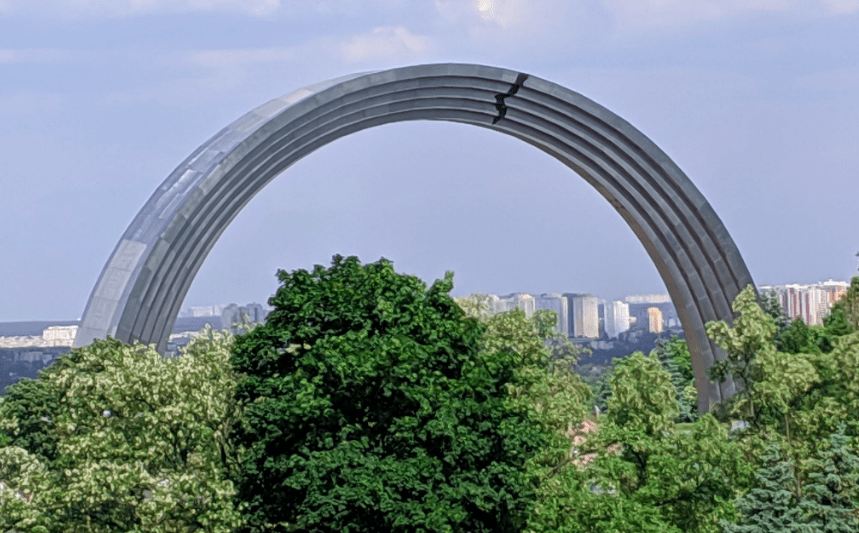
Today is Saturday. We are 10 days into Russia’s full-scale attack on Ukraine. I’m tired, full of worry, and angry. I remain hopeful, but think it’s time I share what’s in my head.
Who am I?
I am a mid-thirties, middle-class, White, American. Those things inform my narrative more than I would care to admit, so it’s important you know them. I love to travel, I have a wonderful partner, and two really sweet cats. I also have friends in Ukraine.
It is because of them that, despite the distance, I am so tired and angry these past 10 days. Because their problems are very real for me, and right now, their problems are that their country is being attacked and they are not always certain they will live through the night.
For the first few days of this conflict, I did what I always do when something scarily important is happening in my life – I obsessed over it and took in as much information as I could. First from my friends who live in Ukraine, since they have first-hand experience to share, and then from the rest of the world.
At first, honestly, I was afraid to bother them… who wants to be texting a friend who can do nothing for you half-way across the world when a neighboring country is trying to snuff out your existence? But what I quickly found was my friends wanted the world to know what was going on. So now I ask pointed questions and still try not to waste their time, but I stay connected while learning what I can.
Let me first share what I learned from them…
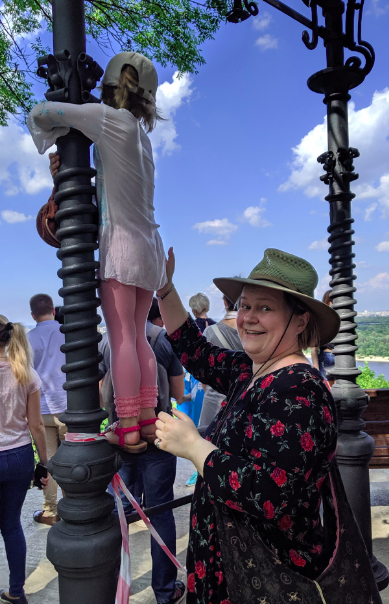
My friends are Maria and Dmytro, and their 7-year old daughter, Tasia. Their family loves science fiction (something we have in common) and Tasia’s favorite fictional setting is the zombie apocalypse. This seems ironic to me, since the closest I’ve ever gotten to experiencing an apocalypse in real life was my walk through Chernobyl. Nonetheless, threats from Russia are common in Ukraine, and so in some ways, it’s not surprising that she has been so crazily calm during the past week.
A few days ago, their family was sitting in their living room, with Dmytro occasionally play-boxing with Tasia to get out some of his nervous tension. They could hear shelling in the background, and to his surprise, Tasia said to him:
“Dad… let me watch YouTube before we get killed.”
When I read this, I cried. No one should be able to say that and mean it. No one should become so numb to threats to their existence. But this threat has been at their door for so long.
Even before the invasion began, Dmytro shared this perspective:
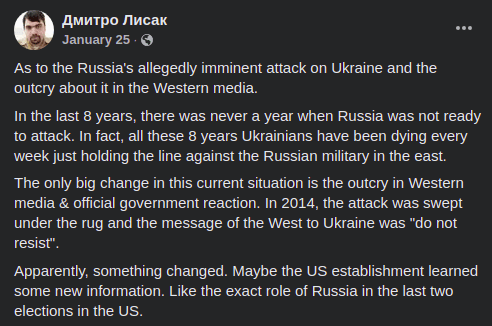
A few days after that moment with Tasia, Maria was interviewed by a Canadian news team. You can listen to the full interview here. What struck me most was this particular exchange:
Reporter:
“How do you think the negotiations are affecting anything in terms of the invasion, if they are at all – I’m referring to the talks happening in Belarus between Ukraine and Russia… do you think they will be helpful at all?”
Maria:
“The only use of those meetings is the hope that Russia won’t be shelling our residential areas during the negotiations. And as previous experience showed, negotiations did not stop the shelling. And you cannot negotiate with someone who is not inclined to listen to you. We have some contradiction here – we want them gone, and they want us dead. So there is not much space for negotiation.“
What a succinct way to sum up what I had been feeling for days as Western countries continuously encouraged President Zelensky and Putin to return to negotiations. What was there to negotiate, really? Russia does not acknowledge Ukraine’s independence, and Ukraine wants to remain independent. There is not much of a middle ground, just a time when one or the other is forced to concede, or at least stand down for the short-term.
At this point I had heard all I needed to from my friends… onward to learn what I could learn from news outlets, journalists, and government sources.
I learned quickly that this was not a world event which I could depend on traditional news mediums for. By the time a major news outlet reported on something, my friends could be dead. I needed something faster and more specific to my friends’ location. Thankfully, we live in a time when such a thing is possible.
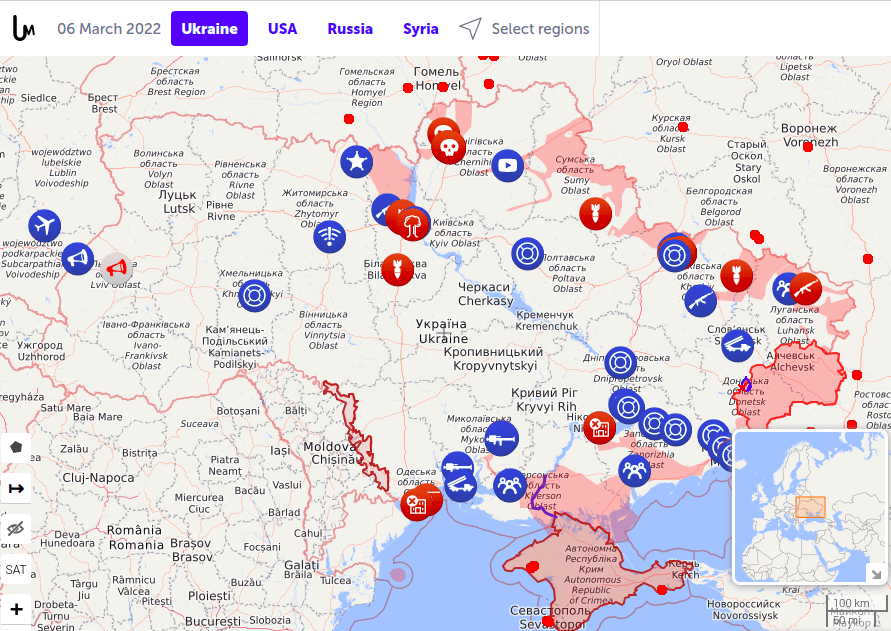
Enter the Universal Live Map. While the original developers are Ukrainian, the map shows views like the one you see above for anyplace in the world. They share updates from various sources – Twitter, Telegram, traditional news sites, etc. They show where on a world map those pieces of information are coming from and then they share a link so that you can go to the source. This allows you to determine if you think the source is valid and/or biased in some way, and thus, if you can trust the information. It happens in near-real-time so that I can see what’s happening minute-to-minute.
On a side note, there’s something deeply fulfilling to me that sources of information like this – open and free – are so much more effective at real-time information sharing than traditional news sources. I will not rant about it today, but be assured that my desperation for information, blocked at so many turns by paywalls the last 10 days, has only further fueled my intensity towards support of open access initiatives.
Anyway, as I said, I obsessed for the first few days. I had alerts on my phone from the Universal Live Map app that shared updates every hour. Every night I found the latest livestream of Maidan Square in Kyiv on YouTube and I left it on while I slept. When the sirens went off, I checked to see if Maria’s Facebook status still showed “online” and then checked the latest Universal Live Map updates.
My friends told me I needed to sleep, but it seemed wrong somehow not to at least be aware if Russian soldiers were in the process of killing my friends.
I guess you could say I was a bit paralyzed by the influx of information. I thought long and deep about every new thing I heard and saw. It’s why I could not write this until now. When I first learn about something, I mostly come away with feelings. The way my brain processes important information doesn’t allow me to put into words what I’m experiencing. This is particularly infuriating when time is not something I have a lot of, since time is what I need for the processing to complete.
Before I go further into conclusions of what I learned, I will do my best to share where I’ve been, both physically in Ukraine and what I’ve learned from the perspective of books I’ve read / listened to. My past experiences have helped me to understand a lot of what’s happening in the context of the past, and I think it’s important.
Before Russia attacked, I listened as President Biden shared Putin’s plans with our allies. I think it was one of the few times I’ve felt incredibly proud of my country, because this decision was key to putting a damper on Putin’s disinformation engines, which in the past have been so powerful, and which would have prevented the rest of the world uniting in Ukraine’s defense.
Unfortunately, in case you’re unaware (as I was prior to a few years ago), Putin has been writing the Russia-Ukraine narrative for the Western world for a long time. It’s embarrassing to think just how little we’ve truly listened and helped up to now.
If you’re not sure what I mean, imagine if you had known President Zelensky back in 2014… would we have let Russia annex Crimea with so little resistance? I had no idea, for instance, that at the time, former President Poroshenko donated 2 billion hryvnias of his own money (the current day equivalent to $65M USD) to support Ukraine’s military. Some of the same anti-air missile systems he funded now protect Ukraine during this war.
Meanwhile, President Zelensky has done an incredible job of presenting Ukraine in the best possible light to the international community, while encouraging his people to stay strong. His acting career has prepared him well for using rhetoric to move people.
In that vein, it’s important to ask how many of us truly know what this war is even about. Honestly, I wouldn’t have except for a trip I took to Ukraine in 2019 when Maria and Dmytro showed me their country. I learned a lot on that trip. Maybe it helps to share it with you.
Maria and I met originally at an Endangered Language conference back in 2008. She talked to me then about the need to keep Ukrainian alive and protect its culture. I understood those words, because I’d been working on preservation projects for Tohono O’odham and Chemehuevi in the Southwestern U.S., but I didn’t really have the life experience to know what it meant. Not really. The closest I’d come to experiencing something like it was people in my hometown debating whether people should speak Spanish in the U.S. because “we’re in America”, despite the United States not having an official language.
But what I learned in Ukraine is that it wasn’t just a scuffle about whether signs could be posted in Spanish along 4th Avenue or not. It was a matter of being recognized at all as Ukranian. The Russian government, and still many Russian people, do not recognize Ukraine as an independent country with its own unique language and culture. In the past, there was a common phrase used for Ukrainians: Malorosy. It means “small Russians”.
But let’s be clear: Ukrainians are not impersonating Russians. In the same way that Canadians are not “small Americans” and Guatemalans are not “small Mexicans”, Ukrainians are not “small Russians”.
Ukrainians made their intentions perfectly clear when they voted for their Independence in 1991. To give you a sense of their support: 82% of their population came to vote, and of that percentage, 90% voted for Independence. By contrast, the United States’ highest voter turnout in the 21st century was for our 2020 Presidential Election – and we only had a voter turnout of 66.8%.
But back to walking through Kyiv… I learned during that walk about the Orange Revolution and Euromaidan (yes, a single walk… my Ukrainian friends are efficient in their history lessons!). The tl;dr is that the Orange Revolution was, in the words of my book Awesome Kyiv, “a protest against corruption and electoral fraud”. While the cute book I bought doesn’t call it out explicitly, my friends did – the corruption mentioned was an attempt by the Russian government to place a Russian-backed President in their country. So Ukrainians protested for 4 months, forced a re-vote, and were able to prevent a Russian invasion of their government.
Then, in 2013, Euromaidan occurred.
Euro – because this was a protest against, again, illegal moves by corrupt officials in government to move away from a trade agreement with the EU that had been promised, and instead move toward agreements which would further enable Russian control.
Maidan – because that is the square where the revolution took place, known in English as Independence Square, or in Ukrainian “Maidan Nezalezhnosti“.
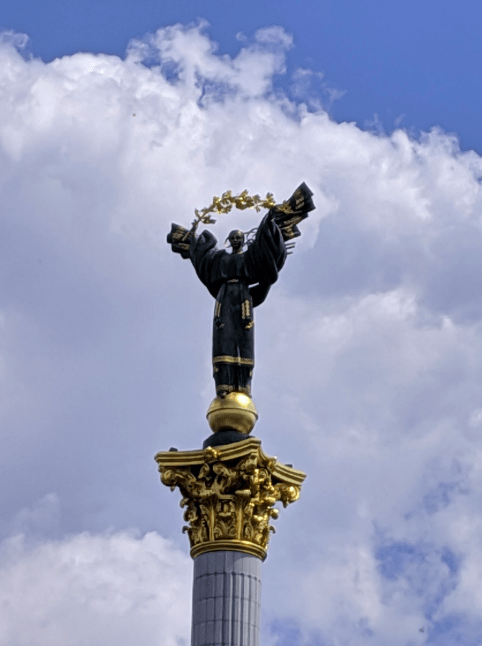
This protest struck me as so significant… people had setup camps in the square, there were kitchens and medical services, and even an “open university” that had a library. People stopped everything to ensure that their will was heard, despite continued government corruption. When was the last time I had fought so hard for my freedom? Never.
Maria stopped to make a point to me as we walked that protesting by Ukrainians was rarely violent. We passed a set of people playing violin and other stringed instruments which, in the U.S., I would have assumed was for entertainment, but in this case was to raise awareness for a cause they were supporting.
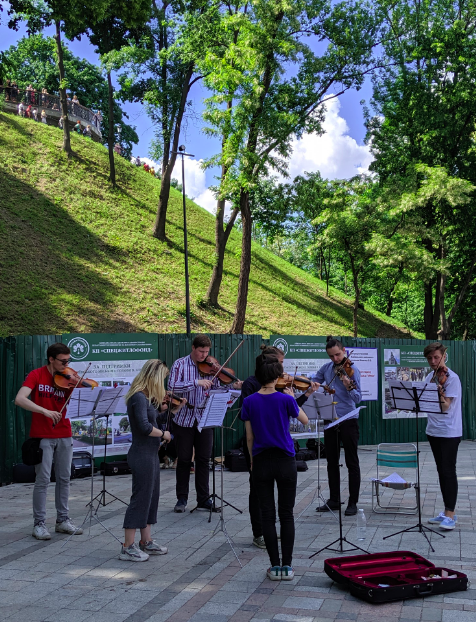
Sadly, during Euromaidan, protesting Ukrainians were attacked by the regime at the time – roughly 300 were killed, many activists were kidnapped and tortured, and thousands more were wounded. But Ukrainians’ resolve to stay despite threat to their lives eventually forced out their corrupt leader and they were able to make progress again.
I share this to say that, I am not at all surprised by the resolve of the Ukrainian people in this war. They have been fighting for their independence and freedom for most of my life.
This is also what I meant when I said I had no real understanding of Maria’s statement that Ukrainian culture was at risk if the language couldn’t remain. Their language is one of the major signs of differentiation between many Ukrainians and the Russian regimes which continually try to overthrow them. I have never had to fight for such a thing. Growing up in a fully democratized country leads to a certain level of unrealized complacency, it seems.
After my tour through Chernobyl, and my friends’ sharing of Kyiv with me, I was incensed to learn more. Ukrainians were true underdogs in the current-day battle for democratic solutions to politics and government. While my conclusions are likely flawed in some ways, the two major learnings I came away with were as follows:
- Putin’s ambitions include a deep disdain for the West and he has already played a part in causing division and confusion in the US and UK with his disinformation machine; it is his strongest weapon against the West outside of nuclear weapons.
- the Soviet political system was mostly to blame for the occurrence and deep spread of radiation during the Chernobyl disaster. The human-political aspect has since been my biggest concern about nuclear energy, and is a constant reminder of why it is important that governments we believe to be trustworthy (and hopefully not accidentally negligent) are leading the countries that keeps these older plants safe.
With Russian troops now occupying Chernobyl, these learnings are as critical and relevant to me as ever.
But now, here I am, having typed a lot and not gotten to the point I’ve meant to make. Apologies, but my brain has had to go through this much to get to where we are. Hopefully it will make the present that much more meaningful.
The present is this: Ukrainians, as always it seems, are in a battle for their independence.
As this war started, I was proud of my President for uniting NATO so quickly and putting a quick halt to Russia’s disinformation before it could really even begin. However, what I didn’t understand at the time, but quickly came to realize, was that NATO would be unwilling to participate in armed conflict in Ukraine.
I had to learn more about how NATO worked – I had never dug deeply into it before and was unsure under what terms armed support could be offered. I learned that only under Article 5 does NATO engage in armed conflict, and only for NATO countries. The only time it had ever been enacted was due to the September 11, 2001 attacks on the U.S. Considering all the other important conflicts since then, I knew immediately NATO would not provide armed assistance to my friends. I was truly disheartened, and it stung every time I saw more people calling for support from NATO or Biden, knowing that there would be nothing.
Yes, we would provide humanitarian support, but that support would not stop Putin’s attacks.
I think the best example I can give for how this feels is an analogy…
Imagine you live in a neighborhood and your neighbor’s house is on fire. They are the only house not in your HOA (Home-Owners Association), but you see their kids out on the street playing with your kids, and their dogs bark at your dogs when you walk by.
So today their house catches on fire and your neighbors are using their hose to try to put it out, but it’s quite a big fire. They need help. So the HOA’s fire department shows up. And they stand ready. Ready to put out fires… if the fire should spread to one of the HOA houses.
But because your neighbor isn’t part of the HOA, they just stand there, outside the fence of your neighbor’s house, waiting in case the fire spreads, while you watch your neighbor’s house burn.
Their daughter is stuck in the house and you want to go get her, but you don’t have the training or the equipment to go in and save her yourself without you both being burned alive.
The HOA fire department could put out the fire… but alas, your neighbors aren’t part of the HOA.
So you watch, listening to them scream and cry for help. And you feel bad, so you offer them a stretcher for their dog that got out but has a burnt leg and you help the dog.
And for a moment, you feel grateful that something good has happened. You and others have helped your neighbor with their dog! It’s a lovely show of support and that we’re all in this together.
Except suddenly it becomes clear that the little girl in the burning house will likely have to die. Because her family’s hose isn’t enough to put out the fire. And they aren’t part of the HOA.
That is how the last 10 days have felt to me.
I recognize that there is more to this. I recognize that a nuclear war with Putin is something that none of us wants. But in my mind, Putin is already at war with us. Because he attacked our neighbors, who have fought most of my lifetime for democracy and peace, and have worked so hard to become part of NATO. The war in Ukraine is about so much more than just Ukraine.
If we lose those neighbors, we lose a huge asset to democracy in the West. If we lose them, then we haven’t managed to stand up to a power that seeks to destroy the progress we as humans have made towards solving disputes economically instead of militarily. And just to be honest, if I lose my friends, I will be angry until the day I die.
What this has taught me is that, today, Democracy has a problem. It is powerful during its early stages, when there is a clear common goal, but then becomes neutered over time, and is especially vulnerable when its enemy plays outside its rules.
Russia’s information wars have worked very hard to teach Americans and Europeans that we are helpless. That the things happening around us are beyond our control. They have fanned the flames of the human paralysis which occurs when there appear to be too many options.
But I refuse to sit and watch this happen, to literally sit and watch my friends die half way across the world and do nothing. I refuse to let Democracy as we know it die this way and with these people.
So today I’m asking that we work together to find our voice and power. To find our strength as citizens of democratic countries and ensure we don’t lose what we’ve collectively worked so hard for.
If it sounds like a lot, I know. It has taken this event to get me to this point. So, let’s learn together.
I don’t have a good answer for the bigger problem yet – how more of us can feel empowered to help when crisis strikes and the problem is not local to us. The reality is, I’m asking you to care about this because it’s so deeply important to me, while knowing full well there are thousands of other things you’re bombarded with to care about each day. For what it’s worth, I’ll be working on that problem with a similar obsession, as soon as I have the bandwidth to do so. If you’re interested in brainstorming with me, you can follow another page I’ve created for those ideas here.
For now though, I at least wanted to share some resources I’ve learned about and which you can contribute to for THIS crisis. They are non-aggressive (except that last one) and they help break the cycle of powerlessness many of us are feeling right now:
- BROKE? SHARE: Helping people understand and empathize with the situation is important to us all taking the right actions to help:
- Dmytro has been sharing his daily experiences with me and others. Here is an example of what their days are like right now.
- Maria was recently interviewed by a Canadian news station and that interview is publicly available.
- LOADED? DONATE: (updated March 20th) I’ve noticed how exhausting it has been for everyone to vet out organizations to donate to. Some places just aren’t efficient with their funds and others are downright scammers. If you’ve come here, you likely know me and my crazy brain… I’ve done some research and want to share it:
- Ukraine’s military needs weapons and drones. For that I recommend Come Back Alive; they work directly with Ukraine’s military so they know exactly what is needed. You can also donate to Ukraine’s armed forces directly if you prefer.
- If you’re a lover, not a fighter, then please consider Razom instead. They came into existence in 2014, after Euromaidan, and have been supporting Ukrainians ever since. That’s important because, unlike other organizations that want to help but are new to Ukraine, Razom actually has the experience and logistical knowledge inside Ukraine to get humanitarian supplies exactly where they need to go. They also have a detailed list on the page I linked of what they are asking people for, so you can see exactly the kinds of supplies your money would be used to purchase.
- PISSED OFF? FIGHT: If you have military experience and want to fight, President Zelensky has opened Ukraine’s borders to citizens of other countries without need for a VISA. Sound crazy? 3,000 other Americans have already signed up. If you are genuinely interested in this path, this guide is a good and realistic list of things to consider and prepare.
If you’ve read this far, truly, thank you. I will say one last thing and then go back to my worrying and fussing and over-thinking.
Something I can’t help but keep thinking about is that Ukraine is not just in this situation now. They have been in this situation since their independence, and they will be in this situation in the future. What I mean is, Russia (and others in the international community) will continue not to acknowledge their independence – their differences as Ukrainians – for a long time to come. Much like elsewhere in the world, it sometimes takes generations and severe power shifts in government before such things are shed from people’s worldview.
So, my final hope is that we remember to acknowledge Ukrainians as their own people long after this conflict is over. That we don’t let their younger generation grow up thinking the rest of the world left them to die today, but instead find they have a whole new set of allies, who never truly saw them before, but have now been impassioned by their spirit, courage, and determination. Please believe in your own power to affect the world, and let’s move forward together to support Ukraine.
Україна переможе!
(Ukraine will win!)
 Exploring Systems